
Blogs Plos One

Everything you ever wanted to know about Kepler 186f
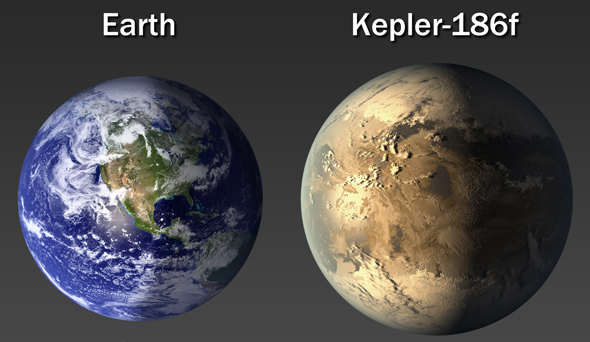
The planet Kepler 186f is 500 light years away, might have liquid water, and orbits a red dwarf star. Red dwarfs are cooler, yes, and dimmer, but they also burn for billions of years longer than our Sun–meaning that life has lots more time to possibly maybe happen there than the 3 billion years it took here. Nearly a thousand exoplanets have been discovered so far. This is the one that most closely resembles Earth.
Hence the wild excitement.
But curb your enthusiasm; there are a lot of ifs and maybes. One tipoff that circumspection is advisable is that Bad Astronomer Phil Plait, who has been known to sometimes jump up and down and yell “Wowee!!!!” isn’t doing that about Kepler 186f.
Plait notes that astronomers have discovered dozens of planets in the habitable zone around stars, the zone where water, if it exists, could be liquid. Kepler 186f is special because it’s 1.1 times Earth’s size, making “it potentially the most Earth-like planet we’ve yet found.” Italics are his.
The known unknowns about Kepler 186f
The fact is, Plait says, we don’t know a lot about Kepler 186f and probably never will. “The techniques used to find planet masses aren’t up to the task for this planet—the star is too dim to get reliable data. The same is true for any air the planet might have as well. And without that, we don’t really know its surface temperature. . . So we don’t know if this planet is like Earth, or more like Venus (with an incredibly thick, poisonous atmosphere that keeps the surface ridiculously hot), or like Mars (with very little air, making it cold). It could be a barren rock, or a fecund water world, or made entirely of Styrofoam peanuts,” he says.
I am guessing he is kidding about the styrofoam, but the question of atmosphere is pretty major. Kepler 186f is at the far edge of the star’s habitable zone. It gets only a third as much light as Earth, and it is colder. So it would need a thick carbon dioxide atmosphere to maintain water as a liquid, according to Alexandra Witze at Nature.
Other reasons for caution: Kepler 186f could have far less surface gravity than Earth–or far more. At ScienceNow, Yudhijit Bhattacharjee says it could be tidally locked to its star, just as the Moon’s rotation is synchronized to Earth. In that case, half the planet would be permanently sunny and the other half permanently dark and cold. If there is an atmosphere, this heating pattern might cause permanent mighty winds.
NASA is guessing that it’s a rocky planet like Earth, but its mass and composition are in fact unknown. A member of the NASA team calls the planet, which is 10% bigger than Earth, an Earth cousin rather than an Earth twin, according to Nathan Ingraham at The Verge.
But maybe this planet is better than Earth?
On the other hand, at SciAm’s Observations, Michael Moyer speculates that Kepler 186f may be better configured for life than Earth is. The little we do know about it suggests that it might nicely fulfill the requirements for superhabitability.

A superhabitable planet is “one that has all the life-giving features of Earth, but more so,” Moyer says. It’s somewhat bigger than Earth, and for generating life, size matters. A bigger planet would help shield nascent life from radiation. It could have more volcanoes spewing CO2 to warm things up, generating a thicker atmosphere that would cling to the planet because of greater surface gravity. Also, lots more space for things to grow and ramble. And a long-lived red dwarf sun that would give life loads of time to get up and running. We don’t know about volcanoes and an atmosphere, but Kepler 186f is bigger than Earth and is orbiting a life-giving (maybe) red dwarf.
Department of Wild Speculation
Switching from speculation mode to wild speculation mode, let me acquaint you with Hontas Farmer, blogging at Quantum Gravity. He is investigating signals from the Kepler 186 system via SETI Live, a volunteer search for signals from intelligent life. Farmer says he has detected something that might might might be a very noisy and degraded broadband signal coming from the Kepler 186 system.
Farmer has concluded there is a better than 50-50 chance that the system harbors not just intelligent life, but intelligent life that is at least as technologically advanced as we are. Or was 500 years ago, the red dwarf’s light having taken that long to be collected by the SETI telescope.
For another leap of the imagination, think on this. If we did find out that Kepler 186f was looking lifelike, 500 light years is far, far away. Even traveling at the speed of light, which as you may know we can’t, it would take many human generations to get there. So you will be pleased to learn that a scientist at NASA (of course) is looking to solve that problem. He’s working on a warp drive. Really. It must be true because I read it in Scientific American.
A guest blog post by Mark Alpert, who (also) writes science fiction, says that physicist Harold “Sonny” White is working on “a system that could generate a bubble of warped spacetime around a spacecraft. Instead of increasing the craft’s speed, the warp drive would distort the spacetime along its path, allowing it to sidestep the laws of physics that prohibit faster-than-light travel. Such a spacecraft could cross the vast distances between stars in just a matter of weeks.”
Sure.

Ad astra ad nauseam
I’ve had enough of the atmosphere around Kepler 186f for now, but if you haven’t, there’s more, lots more.
Joseph Stromberg has an explainer on exoplanets at Vox.
The paywalled paper on Kepler 186f is from Science. Here’s the abstract.
Knight Science Journalism Tracker Charlie Petit has posted an exhaustive analysis of the extensive media response to Kepler 186f. With links, of course. Many.
Calling the pot black
I have written here before about the likely enormous impact of the coming cavalcade of cannabis. We have, somewhat heedlessly, launched a massive experiment. There’s been a revolution in public attitudes on marijuana use–not to mention striking policy changes like legalization in Colorado and Washington state, and legal medical marijuana in 21 other states plus the District of Columbia, and the Justice Department’s declaration that it doesn’t plan to enforce the federal law against weed.
http://blogs.plos.org/onscienceblogs/2014/04/25/goldilocks-exoplanet-marijuana-brain/


