

Jim Ottaviani has been writing science comics long before it was cool to do so. His first book, Two-Fisted Science, appeared in 1997 and was a collection of true stories from the annals of science history. Ottaviani followed that up with a string of wonderful science biographies, including his 2011 biography, Feynman, a New York Times best-seller.
In honor of Niels Bohr’s birthday on October 7, we sat down to chat with Jim about his classic Bohr biography/graphic novel, Suspended In Language: Niels Bohr’s Life, Discoveries, And The Century He Shaped
World Science Festival: Before we get into Mr. Bohr’s life, I’m curious how you fell into doing this. I remember being at MoCCA (a comics festival in NYC) many years ago, and looking at the landscape of comics at that time, I would’ve never thought that science comics would have much appeal…
Jim Ottaviani: You were right!
WSF: …and yet, we look back now, and actually, nonfiction comics are what get the most press these days. They’re much more appealing to adults now. There’s this cultural shift—and maybe it doesn’t translate into millions of books sold, but there is definitely a cultural shift, and it parallels our growing interest in documentary filmmaking now, which is greater than it was 10 or 20 years ago, and I see that people are interested in seeing comics about nonfiction topics. You were totally ahead of the curve on this.

JO: I can’t claim any grand, master-plan here. I liked a lot of the stories; I thought, “more people should know about Niels Bohr. Richard Feynman. Werner Heisenberg. You name it.” I think I’m paraphrasing Carl Sagan here, but our world is so scientifically oriented and based, yet people have so little fundamental knowledge about what’s behind all the things that they rely on: cell phones, satellites, et cetera. And so I’d heard all these entertaining anecdotes about these people who had their names attached to important equations, and thought, “others ought to know about this, and comics are great ways to tell stories. Maybe I can get more people interested in the things that I’m interested in.” So I just gave it a try, and I’ve been giving it a try since 1997 now.
WSF: Bohr’s biography was the first book of yours that I read. The first time I read it, I didn’t know anything about Bohr—just his name, and the revelation of his work, and how you went beyond just hard science and into his political views, and how science affects the world…it was not something I thought a lot about at the time. And that book really just brought it to life. It wasn’t just “hey, here’s his formulas,” and so on.
JO: That’s really nice of you to say. That was the first true full-length graphic novel I did.
WSF: So your book takes this sort of “quantum” approach to his story. You start off with him as an adult, then you go back his childhood, then you jump forward…it’s moving in different thematic ways back and forth, at least the first half of his life. Were you consciously trying to mirror Bohr’s scientific theories, the uncertainty principle, and so on?
JO: Will it sound like I’m smarter if I say “yes?”
WSF: Yes, we’ll all be very impressed…
JO: It came out organically. I hadn’t even thought about it that way, you know, until you just said that. I’m glad it worked for you. I kind of have a tendency to do that with these biographies—I did it in Feynman, and it’s happening in my upcoming Hawking book.
WSF: So one thing that Bohr is a fascinating example of is how society follows and mirrors scientific discovery and vice versa. It’s like, “is Bohr a product of his time, or did Bohr’s ideas create a new sort of paradigm that we follow?” You see scientific breakthroughs reflected in art, and the way people start to think about things. What were the circumstances in Bohr’s time that made it right for him to discover what he did?
JO: Yeah…that’s a really interesting question, especially in the context of the Copenhagen interpretation of quantum mechanics, now that I think about it. How much does the observer affect the experiment? How much does Bohr affect his time, and how much does his time affect him? I’m not sure I have a good answer for this. I think it’s particularly hard with people like Bohr and Feynman…when you look at their lives, and when you read their writing, and when you see what they accomplished and see how forward thinking they are…and how innovative they’ve been…they feel so modern. Even though Bohr was born in the late 19th century. The 1800s! And yet, his ideas and his way of working and the influence he’s had has lasted all the way into the 21st century.
WSF: It still feels cutting-edge. We haven’t really gone past that.
JO: Exactly. And people are still discussing whether this interpretation of quantum mechanics that he was a champion of is, in fact, the right one—and I don’t think we’re going to come to a conclusion anytime soon. (Editor’s note: see the World Science Festival program “Measure for Measure” for a peek at competing quantum mechanics theories)
That said, he was of his time, following the discoveries that were being made on the experimental side. He wasn’t an experimentalist. Watching his fellow physicists—the Ernest Rutherfords, the Marie Curies, the Lise Meitners—he is definitely a product of the experimental work that was being done, and of the crisis that the universe presented classical physics with. He was responding to those things. I expect that he would be responding to this crazy business of dark matter and dark energy, string theory, and black holes in similarly innovative and interesting ways if he were alive right now. So I think the type of curiosity and intellect he had is timeless, but the things that he did were very much of his time. He was bound by the knowledge that existed up through the time he was working as a scientist, and he was keenly interested in interpreting and building on these amazing and baffling experimental results that that were starting to show up.
WSF: Yeah, he really seems to have embraced it, in contrast to someone like Einstein—he really loves those paradoxes.

JO: I think you chose the exact right word: embrace. He embraced all that stuff; he was extremely happy to be living in a time where, “gosh, I don’t think we know anything about what’s going on down there. Isn’t that amazing and wonderful?”
WSF: One gets the sense that he’s kind of an enigma when it comes to what he actually does believe versus “just enjoying the puzzle.” For example, Einstein had very solid ideas, and he followed the logical consequence of his ideas to his death…but with Bohr, you wonder “what did he actually believe?” Tell us what Bohr actually discovered himself. He gave us this atomic model, which he always claimed was not right…right?
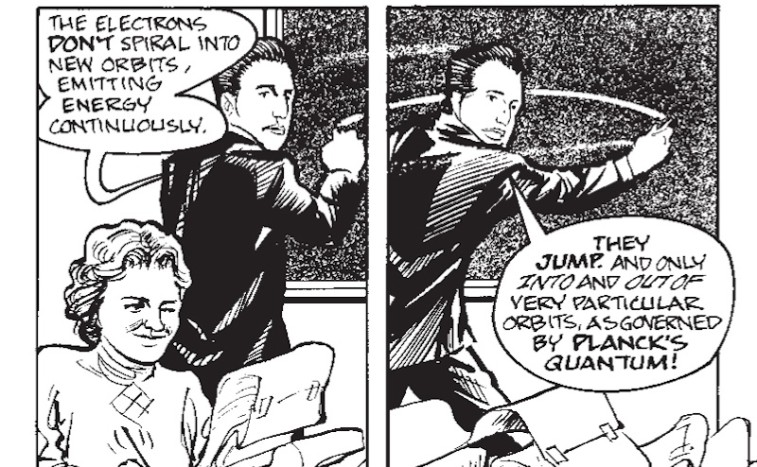
JO: It was shown to be incomplete very soon after he proposed it. But the quantum leap was Bohr’s in saying, “I can explain this hydrogen spectrum that we’re seeing, the emission of photons that we’re seeing, from an excited hydrogen atom.”
Bohr says, “We have to look at electrons as if they are in fixed orbits, and there’s no smooth transition between one and the other. It happens in zero time, as far as we can tell. Now, that’s crazy. There are no midpoints between orbit 1, orbit 2, whatever. That insight is as significant as Einstein’s insight about the speed of light…or that gravity messes with the shape of space. These are fundamental insights that people didn’t have before—and in the case of orbitals, Bohr is the one who lays it all out and says, “if you make this crazy assumption that they can only be in these fixed spots, it explains these bizarre experimental results. So I make that assumption, and I stick with it.” And then he moves on.
I think it’s in his second and third papers on the topic where he starts to get stuff wrong. Not long after, people figure out that the orbits of the electrons are slightly different from what he thought was going on…but it’s that first leap that most people couldn’t even conceive of taking. Maybe didn’t even see that there was a leap to take. That’s the amazing thing.
WSF: We sort of grow up with that being an established fact in this day and age, and it’s hard to remember just how insanely crazy than must’ve sounded when he first said it. A hundred years later, it just seems like “oh yeah. We all know that stuff.”
JO: Yeah. How could it be otherwise?
WSF: The other side to Bohr is the humanitarian side, and that takes a big chunk of your book as well. Can you talk a little bit about his moral principles? What he did in World War II, helping refugees survive Nazi persecution…you’ve got some great anecdotes about how he melted the gold from Nobel Prize medals to keep the Nazis from confiscating them…would you say this is a unique trait among scientists? I think we assume that scientists are a little more amoral in a sense, and they sort of don’t want to get into the messy world of ethics and morals…
JO: That view may be more “United States American” than elsewhere in the world…we don’t have a particularly strong tradition anymore, of public intellectuals. Bohr was a public intellectual. I don’t say this to diminish him, but he was a very big personality in a rather small country.
The Carlsberg brewing company gave him a house! There is beer constantly on tap for him, in that house, throughout the rest of his life…
WSF: A good perk to have…
JO: Yeah. And it’s difficult to imagine this happening today anywhere—and certainly not in the U.S. The closest we get are the annual celebrations…you know, when the Nobel Prizes are awarded, and the MacArthur grants are given…those are the only times when we celebrate our public intellectuals, and we say “Hey, way to go. I’m really glad you got a check for hundreds of thousands of dollars. Looking forward to seeing who wins next year.”
So I think, in that sense, that the times were very different. People like Bohr were lauded more than our scientists are today. And in some sense, I think it’s because the faculty themselves have stepped back. The pressure to do the things that get them tenure, and get them their next grant, don’t necessarily allow for a lot of public engagement. But all the scientists that I know seem to have a strong moral and ethical sense not entirely unlike Bohr. It’s just not as public as Bohr’s was.
WSF: I guess part of it was that he found himself in the midst of one of the most horrible times in human history—and so he had a chance to rise to the occasion, while someone growing up in a peaceful time just never had that occasion to rise up to. So in a way, he stands out because of that.
There’s a new book, Serving the Reich by Phillip Ball, which covers three scientists who worked for the Nazi regime. One of the three scientists is Heisenberg. As you point out in your book, and as is widely known, he stayed in Germany, working for Germany, during the war, while Bohr escaped. They had been collaborators and friends before the war, and worked really closely on such important science issues. I guess I just wanted to talk a little bit about your thoughts on that incident when Heisenberg visited Bohr during the war…

JO: That’s why I do comics about scientists, for one thing, that meeting between Bohr and Heisenberg. You asked how I got into this earlier, and the very specific reason is this Bohr / Heisenberg meeting. I was having dinner with my friend Steve Lieber, a comic artist living fairly close to me at the time. And I’d loaned him a book called The Making of the Atomic Bomb by Richard Rhodes. The story of Bohr and Heisenberg meeting in Nazi occupied Copenhagen is part of that book. We were having dinner and talking about it, and he said, “man—that has tremendous dramatic potential, that story. So many things going on: A world at war. The mentor living in a country occupied by his protégée’s country—Bohr was basically a father figure to Heisenberg. And then Heisenberg comes and visits him, and asks for advice on what to do about, basically, nuclear weapons. And Bohr was just flabbergasted at the question!”
WSF: It’s crazy that Bohr was never able to finish a letter and mail it. You know…that he was overwhelmed with the task of clarifying his mind enough to send a simple letter. It’s clear that there was so much emotional weight behind it, that he just could never do it.
JO: That’s the thing we sometimes lose, in our celebration scientists and their discoveries: how very human they are.
WSF: Yeah, it’s supposed to be this objective endeavor, which I think is what appeals to so many people. Here’s science, it’s math, I can trust this, it’s objective…and yet the truth is, like you’re saying about quantum physics—every piece of every experiment—still has to be interpreted.
JO: And Bohr was fascinated with that as well; that’s where the title comes from,Suspended in Language. He realizes that this quantum world, the subatomic world that his life’s work, is so inexplicable. Language is so inadequate to describe what the mathematics show, what the experiments show. And language is one of those quintessentially human things.
WSF: Bohr realized, again, before most people did, that the atom bomb, and this whole new atomic awareness, was going to change life fundamentally. He was basically saying the same thing as all the ‘open source’ advocates today: “This should be information that all the countries have, and that way we can all work together, and nobody has an advantage…and that way we won’t get into (what basically became) the Cold War…” He’s meeting with all these world leaders, and they’re looking at him like he’s an idiot. Obviously, they’re never going to go down that road. First of all, it’s all so fascinating dramatically, like what you were saying about Heisenberg—the drama of that story is just crazy. But also, if he had been successful, how different our world would be…
JO: And now we’re heading into science fiction…the alternate universe where Bohr gets what he wants, and the secrets of atomic weapons are immediately made available to us all. I think of just our energy future—if we don’t have to justify continued research on atomic energy and weapons by also throwing lots and lots of money at nuclear power…would we have thrown more of that money on other of potential energy sources? It’s hard to imagine what the world might be like today with the effort that went into making better and better or, more accurately, worse and worse bombs devoted towards something else.
As I work on this new Hawking book, I’m realizing that one unintended and unexpected consequence of atomic weapons research was computers with massive computational capability that were, during off-hours, turned towards calculating what happens when stars collapse. And so we have these interesting and amazing discoveries surrounding black holes, and surrounding the idea of dark matter and dark energy because we have the Cold War going on. I’d certainly hate to give up those awesome ideas and discoveries. But…is it worth the tradeoff? Or would we have gotten there anyway?
WSF: Well, thanks for talking with us. I’m going to assume you will never run out of science material to write about, and that it’s something you can do for many years and still get fulfillment out of?
JO: If I’m lucky, yeah. I think so. People have asked that before: “aren’t you going to run out?” I think there’s already enough great material for ten of my lifetimes…and science won’t stop in the meantime.
By: Memo Salazar
http://www.worldsciencefestival.com/2014/10/graphic-look-niels-bohrs-quantum-leap/


