By Travis Saunders, MSc, CEP
 Today’s post comes from Afekwo Mbonu. You can find more on Afekwo at the bottom of this post.
Occupational sitting and health risks
As with sitting more generally, occupational sitting is also associated with increased health risk. For example, a recent systematic review by Jannique van Uffelen and colleagues in the American Journal of Preventive Medicine found that the majority of prospective studies suggest that occupational sitting is associated with increased risk of both diabetes and mortality (the data for body weight, cardiovascular disease, and cancer was less conclusive).
The good news is that simply sitting less may have measurable health benefits. As discussed previously on Obesity Panacea, research from David Dunstan’s labin Australia suggests that frequent light-intensity walk-breaks can greatly reduce the metabolic impact of prolonged sitting. Pronk and colleagues have also reported that the use of a sit-stand device which reduced overall sedentary time by 16.1% per day, significantly improved participants’ moods (i.e., fatigue, confusion, depression and total mood disturbance) and related health outcomes (i.e., upper back and neck pain) compared to baseline, or periods where the sit-stand devices were not available.
While research in this area is still in the early stages, there is sufficient evidence to suggest that disrupting sedentary time may be beneficial to health.
The way forward: Walking Meeting Rooms
With modern technologies forcing employees into sedentary occupations, workplace pressures to maintain long hours, and social norms to “stay connected”, advising individuals to reduce their sedentary time during the workday can be challenging and in some cases, unrealistic.
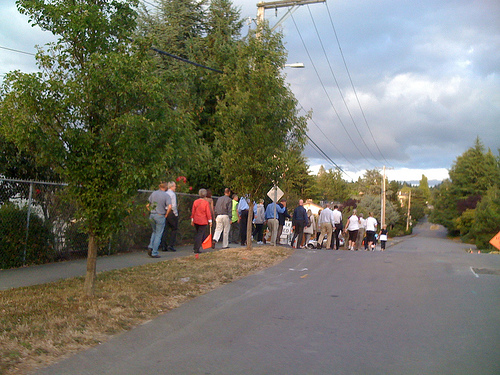
Incorporating walking meetings into the work environment may be a feasible solution. Walking meeting rooms are mapped routes that are used to replace conventional meetings rooms where participants are seated.
Walking meetings can be an effective way of breaking-up prolonged sitting without disrupting workplace productivity. Evidence suggests that reducing sitting bouts during the work day is achievable and such changes do not necessarily disrupt workplace performance.
The HALO group at CHEO’s Research Institute began incorporating walking meetings into their routine in 2012 and have continued to use them whenever possible. This is an effective way of breaking up a sedentary work day. In response to increasing popularity, a series of “walking meeting rooms” were added to the CHEO meeting booking system.
A total of 12 mapped out routes were created as walking meeting rooms ranging in time from 15-60 minutes in duration (1-5 km). These were organized through Microsoft Outlook public folders and set up so that all hospital and research institute staff are able to book a walking meeting room– importantly the walking meeting rooms are never unavailable or “booked” as they can hold multiple simultaneous meetings. In a work setting where booking meeting rooms is always a challenge, the use of walking meeting rooms at CHEO has also reduced the pressure to the find adequate space for all scheduled meetings.

Although many may cite a multitude of problems with walking meeting rooms, most can be overcome with some foresight and planning. Such concerns may be the inability to take notes, or access the Internet; however, with the advent of smartphones and tablets, many programs can record conversations, search the Internet, and capture the ideas of any creative mind while in motion.
Efforts are underway to promote the walking meeting rooms as a healthy active living alternative to sitting meetings, when the size of the group (ideally 6 or less) and the objectives of the meeting can be accommodated.
The goal of this project to track the use of walking meeting rooms in order to provide a metric of ‘usability’, and ultimately to transform habitual sedentary behaviours to those that optimize employee health and wellness. Alex Munter, Chief Executive Officer of CHEO, boasts that “the walking meeting rooms have provoked a rethink of contemporary meeting habits at the hospital and have initiated a movement to get staff moving!”
Concluding Remarks
If you’ve been reading this post while seated, this is probably a good time to break-up your sitting time; and this shouldn’t be restricted to the workplace. If you’ve scheduled your next meet-up with a friend at a coffee shop and anywhere that would keep you seated for a while, you might want to consider taking your friend on a refreshing walk after you get your latte or crème brûlée and enjoy your delicacies while you walk and talk.
http://blogs.plos.org/obesitypanacea/2013/11/06/walk-and-talk-promoting-walking-meetings/
About the author: Afekwo Mbonu is a Master of Public Health (MPH) Candidate at Lakehead University. Her research work is focused on school health and the contextual factors within the school environment associated with the adoption of comprehensive school health programs. She holds a BSc in Biomedical Sciences and a graduate certificate in Population Health Risk Assessment from the University of Ottawa.