
Roxanne Palmer
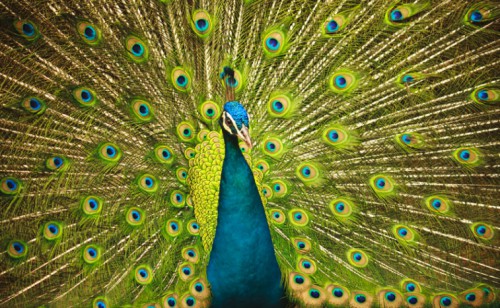
In science, the peacock has long been the standard-bearer of the idiotic things we do for love. The impractically huge fan-like train of the peacock seems, at first glance, to stand against evolutionary principles: Such a large tail clearly must be cumbersome, preventing quick takeoffs and making the male peafowl easy prey for even the laziest of tigers. Surely the principle of natural selection cries out against such wasteful, dangerous ornamentation. “The sight of a feather in a peacock’s tail, whenever I gaze at it, makes me sick!” Charles Darwin wrote to the botanist Asa Gray in 1860.
But the train does come in handy when courting a mate, and evolution tends to favor those who are better at mating. Eventually, Darwin reconciled the insanity of the peacock’s tail with evolution by developing the idea of sexual selection. While the peacock’s large tail might slow him down, peahens seem to like it, making him more likely to reproduce, and this benefit seems to outweigh the cost.
Evolution’s calculus seems to be borne out in the persistence of the tail. So far so good. But just how much of a sacrifice is the peacock actually making? A new study suggests that perhaps this tail isn’t quite the tragically romantic gesture that it’s been advertised as.
“The peacock’s train is one of the classic examples of exaggerated, sexually selected traits,” says Graham Askew, a biologist at the University of Leeds. “The theories about the evolution of such traits suggest that they should have a cost, but there are not many examples of people going out and measuring it.”
Askew took it upon himself to fill in the missing data points. He used high-speed digital video cameras to capture the take-offs of five peacocks with their tails; the experiment was then repeated after clipping off the birds’ tails with pruning shears. The peacocks would be induced to fly from a lower perch to a higher one by an experimenter clapping or rattling a stick at them. By filming the peacocks from different angles, Askew was able to work out the birds’ rate of climb and acceleration—“things that matter if you’re pursued by a predator,” he says—as they launched from their perches.
So, how much did dragging around a giant tail slow down the peacocks? Actually, not that much, Askew says in a recent paper published in the Journal of Experimental Biology. The peacock’s tail “adds a tiny amount of drag, but only a very tiny amount,” Askew says.
The peacock’s tail does double the amount of “parasite drag”—basically all the drag NOT associated with the wing-flapping movements required to sustain flight, but rather, that which is produced by the tail and the rest of the body. But the power the peacock needs to produce to overcome all the parasite drag amounts to just .1 percent of the peacock’s total aerodynamic power generated during takeoff, Askew calculated.
“This is a wonderful result,” Kevin Padian, a University of California, Berkeley biologist who studies the evolution of flight, told us. “It implies that the classic picture of the apparent disadvantage of the peacock’s train is not so bad after all.”
However, both Askew and Padian note that the peacock’s tail affects it in other ways. It costs extra metabolic energy to produce something that heavy (nearly 7 percent of the bird’s body weight). The big tail also provides a convenient handhold (or pawhold, or toothhold) for a predator pursuing a tasty peacock; since Askew’s experimental model does not include predator behavior, the study can’t speak to that point, Padian says.
Overall, the new find refines our understanding of sexual selection as it applies to the peacock, but it doesn’t shake the foundations of the larger evolutionary model. “Organisms will go to extravagant lengths to produce structures and behaviors that take a lot of effort,” Padian says. “However, if they win mates, apparently they are worthwhile to the organisms. If the organisms died overwhelmingly as a result of such effort, then maybe we’d have to rethink the phenomenon.”
http://www.worldsciencefestival.com/2014/09/peacocks-tail-isnt-drag/